“It sounded like a bomb.” Large hot piece of rocket debris crashes near homes. Who’s next?

Reports from the public after launches or re-entries from SpaceX at Boca Chica, Texas, and Vandenberg AFB, California, compare the sound to an explosion, which also shatters windows and cracks concrete. These are not traditional “sonic booms.”

This rocket debris could have killed people or animals or caused a catastrophic fire. Notice the BCC’s language which makes light of the incident and the residents. 1 in 10,000 risk or worse is not a freak accident.

From the BBC

How a freak space junk crash baffled residents and sparked concern
Waihiga Mwaura
BBC Focus on Africa TV, Mukuku village
1-11-25

An eerie whizzing sound followed by a big boom startled Kenyan villagers relaxing recently one afternoon with family and friends.

“It sounded like a bomb, I was shocked. I started looking around, also wondering if it was gunshots,” Stephen Mangoka, a 75-year-old farmer from Makueni county’s Mukuku village, told the BBC.

“I looked up in the sky to see if there was smoke. Nothing.

“I rushed to the road to check if there had been an accident. Also, nothing. That is when someone told me that something had fallen from the skies.”

In fact, a massive round metal object had plummeted from above landing on farmland near a dry riverbed – and it was piping hot.

“We found a big piece of metal that was very red so we had to wait for it to cool before anyone could approach it,” said Ann Kanuna, who told us she owns the land where the object fell.

The giant ring took around two hours to cool down and turn grey – but it had already become a sensation with people arriving to look at it.

The rest of that Monday afternoon – with few people working as it was the day before New Year’s Eve – crowds came to view the giant metallic ring.

It was like selfie central, with people coming to pose next to it and great debates about what it could be.

The local authorities in Makueni county – which is around 115km (70 miles) south-east of the capital, Nairobi – were informed.

The Kenya Space Agency (KSA) then heard about it and made arrangements to come and investigate the next day.

But such was the object’s fame that Mukuku villagers feared it would be stolen overnight.

Together with local officers, some of them took it in turns to stand guard, lighting a fire nearby. They wanted to keep away potential scrap dealers and others wanting to make money out of the curiosity.

It is said to weigh more than 500kg (1,102lb) – around the same as an adult horse – and is around 2.5m (8ft) in diameter, roughly the size of child’s four-seater merry-go-round.

With daylight came more onlookers on New Year’s Eve – followed by the KSA team and the media.

Mukuku had never seen such activity. When the object was carted away later that day by the KSA, the buzz gave way to concerns about what the villagers had had in their midst.

The KSA said its preliminary assessments indicated the object was “a separation ring” from a space launch rocket.

“Such objects are usually designed to burn up as they re-enter the Earth’s atmosphere or to fall over unoccupied areas, such as the oceans,” its statement said the next day.

No-one was injured when it had fallen but some in Mukuku began to complain that the impact of the crash had caused damage to nearby houses.

Christine Kionga, who lives about a kilometre from the crash site, showed us cracks in the concrete of some of the buildings in her home compound. She said they had appeared after the crash.

Other neighbours alleged the structural integrity of their homes had also been affected – allegations that are yet to be substantiated.

“The government needs to find the owners of this object, and get compensation for those affected by it,” Mukuku resident Benson Mutuku told the BBC.

There were reports in the local media that some residents had begun to complain of feeling unwell after exposure to the metallic ring though there was no confirmation from those we spoke to when we visited – nor from the authorities or the KSA.

Nonetheless Mr Mutuku said there were concerns about the long-term effects of possible space radiation.

“This is a space object and we have heard in other similar incidents that there have been effects of radiation affecting even future generations and there is that fear in this community.”

However tests run later by the Kenya Nuclear Regulatory Authority revealed that while the metal ring did have higher radiation levels than the area in which it was found, they were not at a level harmful to humans.

Engineers from the KSA, which was established in 2017 to promote, co-ordinate and regulate space-related activities in the East African nation, are continuing to run other tests to find out more about the object.

The KSA director general said it was lucky that no significant damage was done when the object hurtled to Earth.

“The ultimate responsibility for any damage or injury caused by that space object is on the state in whose jurisdiction that operator may have launched the object,” Brigadier Hillary Kipkosgey told the BBC.

According to the Outer Space Treaty, overseen by the UN Office for Outer Space Affairs, “states shall be liable for damage caused by their space objects”.

“[The ring] is a common item in many rockets and many space objects so it difficult to attribute it to a specific rocket or space object but we have leads but as I said our investigations are not conclusive,” Brigadier Kipkosgey said.

The BBC showed pictures of the object to the UK Space Agency to get the thoughts of its experts.

“The most plausible object it could be is the upper stage separation ring from an Ariane rocket in 2008,” its launch director, Matt Archer, said.

“The satellites are fine, but the actual rocket body has come through and de-orbited.”

The Ariane was Europe’s main rocket launch vehicle, helping more than 230 satellites into orbit, before it was retired in 2023.

It seems the separation ring may have been orbiting Earth for 16 years before making its unexpected appearance in Mukuku.

This is not the first incident of space junk appearing in East Africa.

Just over a year and a half ago some suspected space debris fell over several villages in western Uganda.

And a few days ago, on 8 January, there were unconfirmed reports of what was believed to be space debris burning brightly in the skies above northern Kenya and southern Ethiopia.

As the space industry grows, it is predicted that such incidents will become more frequent – and African governments may need to invest in ways to better detect this speeding space rubbish.

Nasa estimates there are more than 6,000 tonnes of space debris in orbit at the moment.

There are many different estimates about the chances of such junk hitting someone, but most are in the one-in-10,000 range.

Such statistics are little comfort for Mukuku’s residents, who cannot help thinking of what damage the ring could have caused had it landed in the centre of the village instead of on farmland.

“We need assurances from the government that it won’t happen again,” said Mr Mutuku.

Captions:
The rocket ring fell not far from the centre of Mukuku village
The space junk fell just before new year celebrations

https://www.bbc.com/news/articles/clyn9dgdwe3o

Comments due January 17 on SpaceX Starship/Superheavy increased launches and landings – FAA docket # FAA-2024-2006

>>> Comments due January 17, 2025 <<<
Docket No. FAA-2024-2006

Draft Environmental Assessment (EA) for SpaceX Starship/SuperHeavy Increased Cadence

NOTE:
>> The FAA only conducted an Environmental Assessment (EA), not a comprehensive Environmental Impact Statement (EIS), on SpaceX’s proposal.
>> On its project page, the FAA fails to mention Hawai’i or Peru or California as crash zones for these flights.

>> Submit comments electronically to the FAA by Jan. 17 https://www.regulations.gov/commenton/FAA-2024-2006-0114
(comment category appears to be “other”, per the heading on the page)

https://www.faa.gov/media/87636
Executive Summary of the Revised Draft Tiered Environmental Assessment for SpaceX Starship/Super Heavy Vehicle Increased Cadence at the SpaceX Boca Chica Launch Site in Cameron County, Texas November 2024

https://www.faa.gov/media/87646
Full report: Revised Draft Tiered Environmental Assessment for SpaceX Starship/Super Heavy Increased Cadence

From FAA webpage:
“SpaceX proposes to conduct Starship/Super Heavy launch operations from the Boca Chica Launch Site in Cameron County, Texas. SpaceX must apply for and obtain an experimental permit(s) and/or a vehicle operator license from the FAA Office of Commercial Space Transportation to operate the Starship/Super Heavy launch vehicle.

The FAA’s evaluation of a permit or license application includes a review of 1) public safety issues (such as overflight of populated areas and payload contents); 2) national security or foreign policy concerns; 3) insurance requirements for the launch operator; and 4) potential environmental impact. Read more about the history of the Boca Chica launch site and the location of the launch site.

The FAA [held] public meetings on the Revised Draft Tiered Environmental Assessment for SpaceX’s proposal to increase the number of launches and landings of its Starship/Super Heavy vehicle at the Boca Chica Launch Site in Cameron County, Texas.

  • Up to 25 annual Starship/Super Heavy orbital launches, including:
    • Up to 25 annual landings of Starship (Second stage)
    • Up to 25 annual landings of Super Heavy (First stage)

The Revised Draft EA also addresses vehicle upgrades. 

…The FAA has developed a written re-evaluation (WR) addressing the proposed project updates to the location of the expended forward heat shield in the Gulf of Mexico, additional information regarding sonic booms resulting from a landing of the Super Heavy booster, updates to sonic boom modeling, and updates to use of the water deluge system. The WR evaluates whether supplemental environmental analysis is needed to support the FAA’s decision to modify SpaceX’s operator license

Based on the WR, the FAA concluded that the contents of the 2022 PEA remain current and substantially valid and that the decision to issue a modification of the existing vehicle operator license for updated operations for the Flight 5 mission profile for Starship/Super Heavy operations at the Boca Chica Launch Site does not require the preparation of a new or supplemental EA or EIS to support the Proposed Action. “

>> Submit comments to the FAA by Jan. 17 https://www.regulations.gov/commenton/FAA-2024-2006-0114

https://www.faa.gov/space/stakeholder_engagement/spacex_starship
FAA page on SpaceX dockets

https://www.regulations.gov/document/FAA-2024-2006-0114
FAA page with Revised Draft EA SpaceX Starship-Super Heavy Cadence Increase at Boca Chica_508 and public comments

FAA informational materials for its community meetings:

https://www.faa.gov/media/88766
Powerpoint presentation – English
Accede a la presentación en español aquí.

https://www.faa.gov/media/88756
Script
Accede al guión en español aquí.

https://www.faa.gov/media/88746
Display boards
Accede a los carteles en español aquí.

https://www.faa.gov/media/88736
Brochure (see last page — the rainbow behind the launch pad)
Accede al folleto en español aquí.

Also, this independent article on impacts to Hawai’i:
https://www.civilbeat.org/?p=1689159

Also,
https://www.faa.gov/media/76836
Tiered Environmental Assessment for SpaceX Starship Indian Ocean Landings
https://www.faa.gov/media/76841
Finding of No Significant Impact and Record of Decision

FAA considers Musk’s SpaceX plans to crash down near Hawaiʻi without complete environmental review – comments due January 17

From Civil Beat

Public Should Weigh In On Elon Musk’s SpaceX Plans To Splash Down Near Hawaiʻi

Federal authorities have not required a thorough review, or consultation with Hawaiian stakeholders, for Starshipʻs proposed landing zones.

By Lynda Williams
January 10, 2025

Since 2022, Elon Musk and SpaceX has requested larger and larger landing areas near Hawai‘i for their experimental rocket, Starship. Now, the aerospace company is seeking federal approval to launch more frequently and to land even closer to Hawaiʻi, with the current proposal being over 20 times the size of the initial request.

Hawaiʻi stakeholders have never been consulted in the environmental review process. That is not necessary, according to the Federal Aviation Administration, because “the Starship vehicle is planned to land outside of range for impacts to the residents of Hawai’i.”  

That position by FAA glides past a range of potential impacts and concerns. The landing zones lie within waters used by the local fishing industry. They overlap with humpback whale migration routes, and encompass areas of cultural significance, such as Papahānaumokuākea Marine National Monument.

Critics argue that this proximity alone demands greater consultation and scrutiny, not less. Although no public meetings are planned in Hawai‘i, the general public can attend a virtual meeting Monday or submit comments to the FAA by Jan. 17. 

Environmental Reviews

To review the potential impacts of SpaceX landings in the Pacific, the FAA has chosen to rely on a patchwork of assessments rather than conducting a full Environmental Impact Statement, which would provide a more thorough and comprehensive view — and would require a more robust opportunity for community input. 

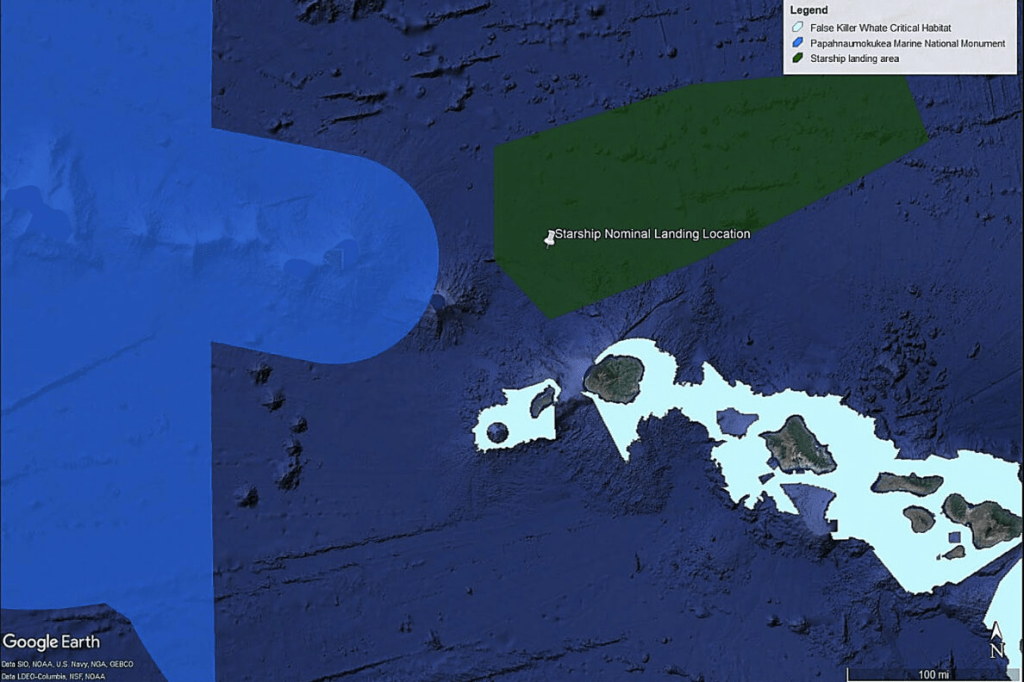
One of the patchwork of assessments was a 2022 look at Starship operations that included Pacific landing areas located 62 nautical miles north of Kaua‘i and west of Papahānaumokuākea, the largest contiguous marine reserve in the U.S. The upper stage of Starship is designed to crash into designated landing zones in the ocean, where it is intentionally exploded on impact to minimize retrieval risks and costs.

The 2022 proposed landing area for Starship in green; the Papahānaumokuākea Marine National Monument in blue; false killer whale critical habitat in turquoise. (Federal Aviation Administration)

In 2023, SpaceX revised its Starship plans, and received FAA permission to add an additional area southwest of Hawai‘i for debris fields from launches that were not configured to survive atmospheric reentry. Despite no additional environmental review, the FAA granted SpaceX a launch license that year for up to five landings per year in the Pacific.

The 2023 expansion of potential Starship debris fields is shown in red. (Federal Aviation Administration)

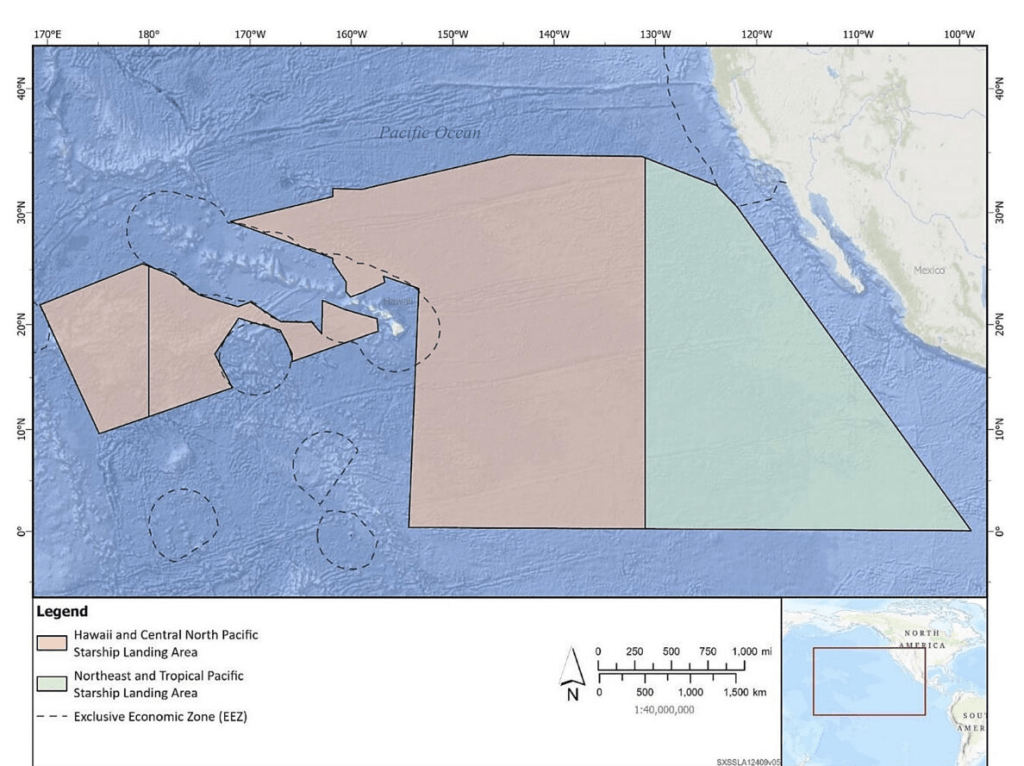
SpaceX is now seeking approval to expand its operations in the Pacific again. This plan would increase allowable Starship launches and landings from five to 25 a year, and would expand the hazardous landing zones across the Pacific, from Hawaiʻi to California, including waters surrounding the Pacific Islands Heritage National Marine Monument and Papahānaumokuākea.

SpaceXʻs new, much larger proposed Starship landing area. (Federal Aviation Administration)

The FAA confirmed that it started formal consultation with the National Marine Fisheries Service on Nov. 27 to evaluate the potential impact to marine species and critical habitats in the expanded Pacific Ocean landing areas. A biological opinion is due within 135 days. 

This current review builds upon the previous 2022 biological opinion that concluded Starship landings would cause no harm to marine mammals and critical habitats.

However, that assessment relied only on best-case scenarios, such as the assumption that Starship would completely disintegrate upon impact and detonation. Had FAA required a full environmental impact statement, potential errors or mishaps would need to be considered.

There was also no consultation with the Office of Hawaiian Affairs, which is a co-trustee and manager of Papahānaumokuākea.

Accidents And Lawsuits

As of now, no Starship landings have taken place in the Pacific Ocean.

The first test flight on April 20, 2023, which aimed for a Pacific landing, ended in a catastrophic explosion shortly after liftoff over the launch pad at Boca Chica, Texas, scattering debris across sensitive wetlands and wildlife habitats. The blast also created a shockwave that shattered windows in nearby homes and launched a cloud of dust and particulate matter that blanketed the surrounding community.

The incident sparked significant outrage from local residents, environmental groups, and Indigenous communities, who criticized the FAA for insufficient oversight and what critics described as rushed approvals.

Several environmental organizations, including the Center for Biological Diversity, as well as the Carrizo/Comecrudo Tribe of Texas, have sued FAA over its approval process, arguing that it failed to require a full EIS and account for worst-case scenarios. The lawsuit is pending.

Accountability And Public Input

Musk has repeatedly criticized the FAA’s regulatory requirements for SpaceX operations at Boca Chica, mocking the need to assess potential impacts on marine life and quipping that if Starship hit a whale, “the whale had it coming.”

Although the FAA has not required a full environmental impact statement at Boca Chica, the Defense Department does require one for Cape Canaveral — regulations Musk has never publicly criticized. His role in the incoming Trump administration’s government efficiency initiative, where he has pledged to put regulations “on the chopping block,” has raised concerns about possible conflicts of interest, especially as his companies have over $8 billion in government contracts.

A full environmental impact state would trigger what is known as a Section 106 consultation, requiring federal agencies to assess potential impacts on historic and cultural sites, and consultation with Hawaiʻi stakeholders like OHA. 

That is why it’s crucial residents of Hawaiʻi speak up now and demand a full review be conducted by SpaceX to protect our waters, culture, and islands — because the Pacific Ocean is not a dumping ground for Elon Musk’s ego trip to Mars.

An online public meeting will be held at 1:30 p.m. Monday [Jamuary 13]. Registration is required. Public comments are due by Jan. 17 and can be submitted at Regulations.gov. For meeting documents and additional information, visit the FAA SpaceX project website.

Lynda Williams is a physicist and environmental activist based in Hilo.

https://www.civilbeat.org/?p=1689159

Posted under Fair Use Rules.

Keep Space for Peace Week — October 5-12, 2024

From The Global Network Against Weapons and Nuclear Power in Space
https://space4peace.org/keep-space-for-peace-week/

In 1999 the United Nations General Assembly declared that October 4-10 every year would be designated as ‘World Space Week’ to “celebrate the contributions of space science and technology to the betterment of the human condition” – we ask people to recognise this as a time to Keep Space for Peace.

Each year the GN provides a poster for use to highlight the Week of Actions and posts a list of the actions organised by our members.


Keep Space for Peace Week
October 5-12 202
4

With the current US-NATO expansion happening worldwide, seeking full spectrum dominance, we are viewing our Keep Space for Peace Week this year as the most important one since the Global Network was founded in 1992. The prospects for space-directed WW3 between the US-NATO and Russia, China and Iran are greater than ever.

Most of the global public has little to no understanding how space technology these days is in the driver’s seat of modern warfare. Thus we feel the enormous need to increase our efforts to help plant the seeds in the international public consciousness about keeping space for peace.

So we hope that you and others in your community will find ways to help us reach out to the people and sprout these crucial seeds during this extremely dangerous moment.

VIDEO

Download keep space for peace week poster 2024

Organize a local event
Be sure to let us know about any event
you organize in your local community during keep space for peaceweek. We will add it to our events list

Check events page: https://space4peace.org/events/

Events at military bases, space tech production facilities, launch sites, outside government buildings and more.
Please check out & share one of our short space videos.
See our video list here

More info at www space4peace.org

International peace organizations oppose aerospace expansion on California coast

From CODEPINK

Please join CODEPINK, World Beyond War and the Central Coast Antiwar Coalition to urge lawmakers and policy advocates to invest in the peace economy co-ops, community land trusts, farmers markets and community gardens–and to stop funding the expansion of aerospace: missiles, bombs and rockets for the rich.

Send a letter below to lawmakers, policy advocates and college administrators to oppose plans to expand the war and private space industry on the Central Coast of California. Tell them to invest in the peace economy instead.

Letter to personalize, edit, and send.

https://www.codepink.org/stopaerospacece

December 15: California Coastal Commission considers two Vandenberg rocket launch projects

On Friday, December 15 the California Coastal Commission considers two rocket launch projects located at Vandenberg Air Force Base. The public can submit comments beforehand and also speak in-person or via zoom at the meeting, which will be held in the city of Santa Cruz.

https://www.coastal.ca.gov/meetings/agenda/#/2023/12 (click on Friday tab)
To speak at the Friday meeting, click on the “Submit Speaker Request” at the top of the page by Thursday.

Item # 8. Federal Consistency

  • b. Consistency Determination No. CD-0010-22 (United States Department of the Air Force, Santa Barbara County)–- Consistency determination by the United States Department of the Air Force for construction and use for up to 48 launches per year of a space launch complex for Phantom Space Company at former site of Space Launch Complex 5 on Vandenberg Space Force Base, Santa Barbara County (HW-SF)
  • c. Negative Determination No. ND-0009-23 (U.S. Space Force, Santa Barbara County) –- Commission determination on 1) whether the Commission’s June 2023 concurrence with the U.S. Space Force’s Negative Determination (“ND”) for increases in space launch activities by Space Exploration Technologies Corporation [SpaceX] at Vandenberg Space Force Base (“federal activity”) remains valid due to substantially different effects on coastal uses or resources than originally described in the ND; 2) whether the federal activity’s substantially different effects on coastal uses or resources are still consistent to the maximum extent practicable with the enforceable policies of the California Coastal Management Program (“CCMP”); and 3) if the substantially different effects are found inconsistent to the maximum extent practicable with the enforceable policies of the CCMP, whether staff should prepare and send a letter to the U.S. Space Force requesting remedial actions

Background:

SpaceX
In June 2023, the Coastal Commission improperly approved SpaceX launches at Vandenberg AFB to increase from 6 per year to 36 per year. The proposal was not listed on the agenda as required by California law [1] but hidden in a staff report. In December, the Commission is now bringing back the SpaceX project for reconsideration for whether that approval remains valid and what actions it should take.

Phantom Space Company
The Phantom Space Company project was originally slated for a June 2023 hearing to consider 48 launches and 48 static fire engine tests per year but it was postponed. Now it is back for consideration.

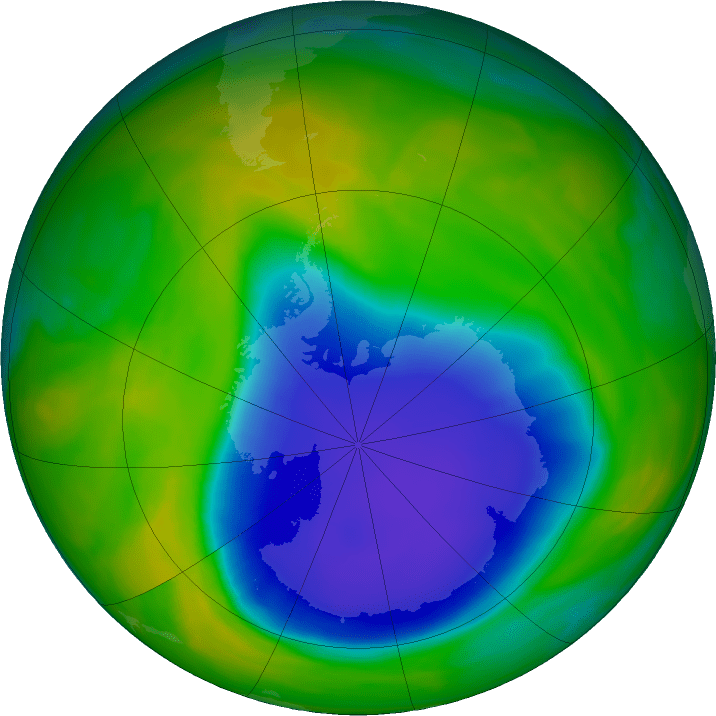
The Coastal Commission has some jurisdiction over federal projects in the coastal zone, but it has limited itself by not considering the nature and scope of damage from these rocket launches and satellites to the coastal region (atmosphere, air, water, and land) and coastal resources, and by not taking into account the extensive environmental damage by both the Air Force over decades and now SpaceX. That includes toxics contamination, ozone layer damage, and climate change.

Written comments can be sent via the links in the agenda for these projects. Staff reports with project information are linked in the Friday agenda under item #8 Federal Consistency.
https://www.coastal.ca.gov/meetings/agenda/#/2023/12

– – – –

Original project documents from June 7 agenda under “Energy, Ocean Resources & Federal Consistency”
https://www.coastal.ca.gov/meetings/agenda/#/2023/6

SpaceX
Item # 10 (inside Energy, Ocean Resources & Federal Consistency Report, pages 1, 8-12)
ND-0009-23, Increase in frequency of space launch operations by SpaceX at Vandenberg Space Force Base (Santa Barbara County)

Phantom Space Company
Item #11A Consistency Determination No. CD-0010-22 (United States Air Force, Santa Barbara Co.) charts and appendices linked in the report
Also at
https://documents.coastal.ca.gov/reports/2023/6/W11a/W11a-6-2023-report.pdf

– – –

[1] California Government Code Section 11125(b) This is part of the code is known as the Bagley-Keene Open Meeting Act and applies to state agencies

(b) The notice of a meeting of a body that is a state body shall include a specific agenda for the meeting, containing a brief description of the items of business to be transacted or discussed in either open or closed session. A brief general description of an item generally need not exceed 20 words. A description of an item to be transacted or discussed in closed session shall include a citation of the specific statutory authority under which a closed session is being held. No item shall be added to the agenda subsequent to the provision of this notice, unless otherwise permitted by this article.

From the California Attorney General:

“In addition, at least ten days prior to the meeting, bodies must 7 prepare an agenda of all items to be discussed or acted upon at the meeting. (§ 11125(b)…The agenda needs to contain a brief description of each item to be transacted or discussed at the meeting, which as a general rule need not exceed 20 words in length. (§ 11125(b).) The agenda items should be drafted to provide interested lay persons with enough information to allow them to decide whether to attend the meeting or to participate in that particular agenda item.”

From the Department of Consumer Affairs:

“…General agenda items such as “New Business,” “Old Business,” “Executive Officer’s Report,” “Committee Reports,” “President’s Report,” “Miscellaneous,” etc., without specifying the particular matters thereunder, lack sufficient specificity to meet the standards of the Open Meeting Act and cannot be used to circumvent the notice requirement of a specific agenda. The Office of the Attorney General has opined that: “… the purpose of subdivision (b) [of Government Code Section 11125] is to provide advance information to interested members of the public concerning the state body’s anticipated business in order that they may attend the meeting or take whatever other action they deem appropriate under the circumstances. * * * “We believe that Section 11125 was and is intended to nullify the need for . . . guesswork or further inquiry on the part of the interested public.” (67 Ops.Cal.Atty.Gen. 85, 87). Items not included on the agenda may not be acted on or discussed, even if no action is to be taken by the agency.”

FAA rubberstamps SpaceX anti-ocean project

Posted in the Honolulu Star Advertiser

Hawaii needs to have input on SpaceX ocean-landing plan

By Lynda Williams

APRIL 27, 2023

The world watched aghast as SpaceX blew up its own spaceship on April 20, four minutes after launch due to engine failure. Even though the mission was not completed, Elon Musk, CEO of SpaceX, claimed it was a success because the real goal was for the rocket to clear the launch pad at the spaceport in Boca Chica, Texas.

What most folks don’t know or realize is that Starship was always going to blow up when it crashlanded in the Pacific Ocean, just 62 nautical miles north of Kauai and a few hundred miles east of the Papahanaumokuakea Marine National Monument.

In the next test launch, which Musk boasted will happen in the next few months, the world’s largest spaceship will descend toward Earth in free fall and blow up upon impact with a force of a ton of TNT as fuel ignites in a great explosion. On a second and third launch test, Starship will break up in the atmosphere and tumble down and crash-land in a debris field several hundred miles southwest of the island chain.

SpaceX obtained a Federal Aviation Administration (FAA) commercial space launch license (experimental permit), rubber-stamped by the National Oceanic and Atmospheric Agency (NOAA) without any consultation of Hawaii’s people because, according to an email I received from the FAA: “No in-person public outreach was conducted in Hawaii as the Starship vehicle was planned to land outside of range for impacts to the residents of Hawaii.”

First of all, that is assuming everything goes exactly according to the plan, which we have all just witnessed doesn’t always happen. If the Starship goes off course by even a few degrees, the consequences could be catastrophic to Hawaii.

Secondly, I think most folks in Hawaii would agree that 62 miles north of Kauai is considered Hawaii culturally if not legally, and that is way too close for what is essentially a rocket bomb to crash-land.

SpaceX was not required to do a full environmental impact study (EIS), but a much-weaker environmental assessment (EA) that only requires the analysis of “nominal operations” or bestcase scenarios. Why was that allowed when the worst-case scenarios are so catastrophic?

In the EA, rather than doing a detailed analysis of the potential impact to marine mammals protected by the Endangered Species Act, NOAA wrote a “Biological Opinion” that argued “less than one” animal would be harmed by a 100 ton steel rocket exploding with the energy of a small nuclear bomb.

It came to that conclusion because it analyzed only one “nominal” scenario in which the rocket hits the water exactly horizontal to the surface with the fuel tanks orientated on top, which is impossible to control or predict. If the explosion is above water, NOAA argues, only a fraction of the energy will be transmitted into the ocean and travel deep enough to harm any of the 30 endangered species of whales, sharks, turtles, monk seals, dolphins and rays in Hawaii.

The EA has many unsubstantiated claims, such as no animals would be near the surface of the water during the crash — even though most are mammals that surface to breathe air.

It ignored the fact that Humpback whales migrate through the target “action area.” It assumed that most of the debris will be large enough to sink to the bottom of the ocean without encountering and injuring animals — but if any does drift into the Papahanaumokuakea Marine National Monument, then the Coast Guard would be sent to clean it up.

This alone is reason to contest the EA and demand an EIS since NOAA and the Office of Hawaiian Affairs co-manage Papahanaumokuakea and OHA should have been consulted, but was not.

The FAA and NOAA analyses are flawed, and both are failing in their duty to protect the people of Hawaii from extreme corporate and federal government abuse.

Hawaii must not become collateral damage and a colonized sacrifice zone for the government’s privatization of the space program and a billionaire’s personal ambition and corporate profits.

At minimum, the FAA must suspend the SpaceX license, conduct a full EIS and include the residents of Hawaii in the review process. The best plan is to ban SpaceX from trashing people and planet in Musk’s ego trip to Mars.

ISLAND VOICES

Lynda Williams is an environmental activist and investigative science journalist living in Hilo.

https://www.staradvertiser.com/2023/04/27/editorial/island-voices/column-hawaii-needs-input-on-spacex-ocean-landing-plan/

Look Before You Launch: What NEPA Requires of the FCC

From the Natural Resources Defense Council

by SHARON BUCCINO Senior Director, Land Division, Nature Program
September 8, 2021

Who knew that the Federal Communications Commission (FCC) is an environmental agency?  But taking the environment into account is what Congress requires of the Commission and what the public needs from it.  Passed over 50 years ago, the National Environmental Policy Act (NEPA) recognized the continuing responsibility of the entire federal government “to use all practicable means . . . to attain the widest range of beneficial uses of the environment without degradation, risk to health or safety, or other undesirable and unintended consequences.”  42 U.S.C. 4331(b).  If we are to sustain the one earth we have to live on, all federal agencies must take into account the impact their actions have on the environment.

Yet, earlier this year, the FCC authorized SpaceX to deploy almost 3,000 low-earth orbit satellites as part of the company’s Starlink system – a mega-constellation to provide satellite-based internet services.  Several other companies, including Amazon, are also pursuing similar mega-constellations of satellites to provide internet services around the world.  Never before have humans put so much into space.  With the FCC’s licensing approval, SpaceX alone will launch more satellites in the next 15 years than have been put in space over all of human history. 

This licensing is exactly the kind of federal action that Congress intended to be taken only after a thorough assessment of its potential environmental impacts.  As the Supreme Court said when reviewing a proposed ski resort in a national forest, “NEPA ensures that important effects will not be overlooked or underestimated only to be discovered after resources have been committed or the die otherwise cast.”

The FCC, however, has chosen to brush aside its environmental review responsibilities.  NEPA requires federal agencies to include “a detailed statement” (an Environmental Impact Statement or EIS) regarding the environmental impact of any “major Federal actions significantly affecting the quality of the human environment.”  If the agency is uncertain about whether its action will significantly affect the environment, it can prepare an Environmental Assessment (EA) to determine if a Finding of No Significant Impact (FONSI) is justified.  The FCC has done neither.  Instead, the Commission has categorically excluded all of its actions from NEPA review, identifying only a few limited exceptions in its regulations.  47 C.F.R. 1.1306.  Such widespread, indiscriminate use of categorical exclusions (CEs) belittles NEPA’s mandate.

Environmental harm from the proposed satellite mega-constellations is not mere speculation.  The increase in commercial satellites has already created significant light pollution.  Designed with a short useful life, the Starlink satellites will add significant debris and chemicals to the atmosphere.  In particular, combustion of satellites upon re-entry produces significant quantities of alumina.  Alumina can deplete the ozone layer we have worked so hard internationally to protect.  It can also increase global warming, whose catastrophic consequences we seem to be experiencing almost every day.  As two scientists recently warned in their peer-reviewed article, Starlink’s deployment “risks multiple tragedies of the commons, including tragedies to ground-based astronomy, Earth orbit, and Earth’s upper atmosphere.”    

NEPA doesn’t prohibit the FCC’s authorization of commercial wireless communication services from space, but it does require that the FCC analyze the environmental impacts of doing so before the Commission authorizes the launch.  The FCC has consistently refused to do so.

The FCC’s blind approach to satellite launch approval is yet the latest example of the Commission’s disregard for its environmental responsibilities.  In 2018, the FCC changed its rules to eliminate the application of NEPA (as well as the National Historic Preservation Act) to its authorization of small-cell networks increasingly relied upon to provide 5G services across the country.  NRDC, together with 16 Indian Nations, sued the FCC.  A federal court found the FCC’s action unlawful.

More recently, the FCC terminated its inquiry into the adequacy of its health standards for radio-frequency radiation without changing any of the limits – even though these limits are over 20 years old.  Again, the courts found the FCC’s action unlawful. 

The public deserves better from its servants at the FCC.  We face a pivotal moment as commercial communication moves into space at a scale never seen before.  Congress anticipated such moments when it passed NEPA.  By working with experts both inside and outside the government, the FCC can collect the information it needs to assess the environmental impacts of its actions before it takes them.  Launching before looking serves no one.

https://www.nrdc.org/experts/sharon-buccino/look-you-launch-what-nepa-requires-fcc
With additional links

Popular Mechanics: Increased Spaceflight Will Warm Earth’s Stratosphere 4 Degrees

From Popular Mechanics
June 28, 2022

Excerpt:

Black carbon in the atmosphere is like dressing Earth in a black shirt on a sunny day. It attracts and holds heat, leading to overall warming of the atmosphere. Airplanes also emit carbon pollution in this way, but there are a few key differences. First, airplanes emit respectively less carbon because they’re taking off in a way that doesn’t fight physics as much. And second, virtually all commercial airliners max out in the troposphere, one layer below the ozone-key stratosphere. (For what it’s worth, airlines are working to reduce carbon emissions and have been testing things like a hydrogen airliner and a partly electric airliner.)

For its study, NOAA used today’s baseline for carbon pollution, which is 1,000 tons of rocket soot per year. Then the team multiplied that figure by 10, which it says is a believable estimate given the recent increase in rocket launches, as well as global plans over the next few decades. At this projected rate, the amount of rocket fuel soot in the stratosphere would raise the temperature in that layer by up to 4 degrees Fahrenheit.

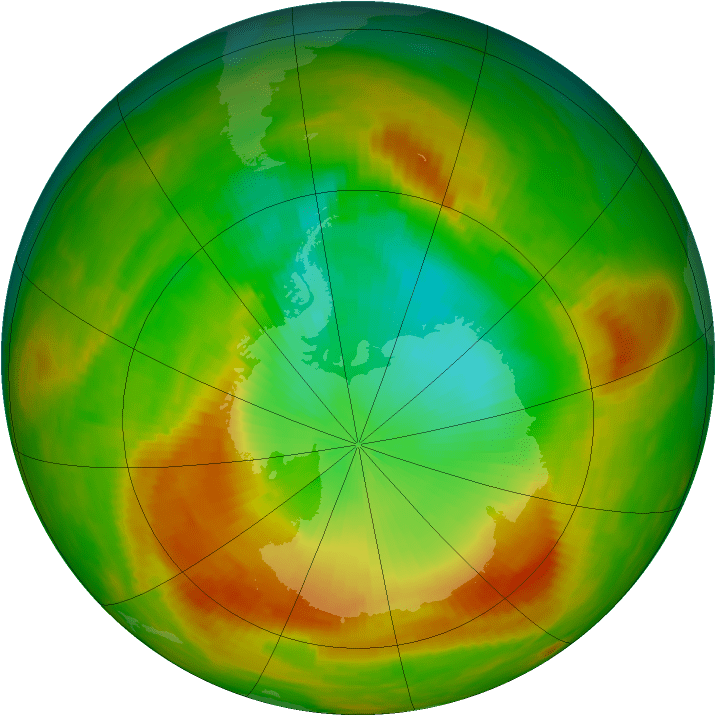
It’s the rising temperature that, in turn, affects the ozone layer. Well, it’s not just that. The rising temperature also affects atmospheric circulation, which is the complex overlay of wind currents that push air all around the world all the time—like jet streams or polar vortices. The rising temperature NOAA is forecasting will dampen some jet streams by as much as 3.5 percent. Both the rising temperature and the change in the jet streams will reduce ozone in global latitudes north of Houston, Texas, by as much as 4 percent.

[Note: This is only one mechanism of ozone loss that NOAA modelled.]

https://www.popularmechanics.com/space/rockets/a40433989/increased-spaceflight-will-hurt-the-ozone-layer/