Public Meeting: Tuesday, October 21 · 6:30 p.m. Cielo Azul Elementary School Cafeteria 3804 Shiloh Road NE (Off Unser & King Blvd)
What’s Happening
A company called Castelion Corporation proposes to build a hypersonic missile/rocket manufacturing and testing facility (“Project Ranger”) on New Mexico State Land Office property in Sandoval County, roughly 3 miles west of Northern Meadows and 4 miles northwest of Camino Crossings, North Hills, and Sierra Norte.
This project poses serious environmental, health, and safety risks for the entire Middle Rio Grande Valley.
Environmental and Health Impacts
🚱 Water Contamination Risks
Rocket propellants such as hydrazine, ammonium perchlorate, and aluminum powders contaminate groundwater.
Perchlorate affects thyroid function at parts-per-billion concentrations.
Nearby Rio Rancho aquifer recharge zones could be permanently damaged.
Similar contamination occurred at White Sands Missile Range and Hill AFB (UT), where cleanup has taken decades.
Relevant laws: Safe Drinking Water Act (42 U.S.C. §300f et seq.); Resource Conservation and Recovery Act (RCRA).
🌬️ Air Pollution & Public Health
Test firings emit hydrochloric acid, aluminum oxide, and fine particulates that worsen asthma and cardiovascular disease.
Manufacturing releases volatile organic compounds (VOCs) and nitrogen oxides regulated under the Clean Air Act (42 U.S.C. §7401 et seq.).
Stratospheric rocket emissions contribute to ozone depletion and climate forcing.
🔊 Noise & Vibration
Engine testing can exceed 150 decibels, disturbing sleep, wildlife, and damaging property foundations.
Low-frequency vibration travels miles across mesa terrain.
🔥 Safety & Emergency Risks
Propellant explosions or accidental ignition could trigger massive fire and toxic plumes.
County lacks specialized hazmat response and containment infrastructure.
Similar incidents at Aerojet Sacramento and Thiokol Utah led to Superfund cleanups.
Relevant laws: Emergency Planning and Community Right-to-Know Act (EPCRA); Comprehensive Environmental Response, Compensation, and Liability Act (CERCLA).
🌍 Wider Regional and Climate Impacts
Hypersonic weapons testing worldwide (e.g., Edwards AFB CA, Eglin FL, and Tullahoma TN) has left toxic residue, fuel spills, and PFAS-contaminated firefighting foam sites.
The U.S. military is the single largest institutional greenhouse-gas emitter; each hypersonic test releases tons of CO₂ equivalents.
Facility could draw millions of gallons of cooling and process water, worsening drought and water-rights conflicts.
⚖️ Legal and Ethical Concerns
NEPA (42 U.S.C. §4321 et seq.) requires a Full Environmental Impact Statement (EIS) before any federal or state action.
State Land Office leases must comply with New Mexico Environmental Improvement Act and Water Quality Control Act.
Local governments may demand conditional-use permits with strict environmental review.
Economic & Community Costs
“High-tech jobs” are typically short-term and specialized; long-term benefits flow out of state.
Property values drop near explosive-testing sites.
Cleanup costs from contamination usually fall on taxpayers, not contractors.
Key Questions for the Public Meeting
Has a NEPA Environmental Impact Statement been initiated?
What chemicals, fuels, and propellants will be used or stored onsite?
How much water will the facility consume daily and from which aquifer?
What is the blast-radius safety zone and how will the public be notified of tests?
Will Sandoval County fire and emergency services receive federal funding for hazmat preparedness?
How will hazardous waste and perchlorate-bearing materials be disposed of?
What monitoring will be done for air, soil, and groundwater contamination—and who will oversee it?
What is Castelion Corporation’s ownership and contracting history with the DOD?
Will the state lease require environmental insurance or cleanup bonding?
Why was this sited near residential communities instead of existing military ranges like White Sands?
📢 Our Demand
➡️ Suspend all approvals until a full Environmental Impact Statement (EIS) and public health risk assessment are completed. ➡️ Protect community water, air, and safety. ➡️ Hold Castelion Corp and the State Land Office accountable to residents, not defense contractors.
Together we can say:
“No Hypersonic BOMB Factory Protect People, Water, and Future Generations.”
City announcement: there was no information given from the city about the project, just the meeting announcement
A public meeting is taking place regarding a proposed hypersonic missile/rocket manufacturing and testing facility, referred to as “Project Ranger.”
The facility would be located approximately 3 miles west of the Northern Meadows community and approximately 4 miles northwest of the Camino Crossings, North Hills and Sierra Norte communities in Rio Rancho.
The public meeting will occur on Tuesday, 10/21 at 6:30 p.m. at the Cielo Azul Elementary School cafeteria (3804 Shiloh Road NE – accessed by traveling Unser Blvd. to King Blvd.).
At the public meeting, those associated with the project will provide information and answer questions from the public. Castelion Corporation is behind the project, which would be located on NM State Land Office property in Sandoval County.
Anyone interested in challenging this should show up to the meeting Tuesday evening
Elon Musk’s massive xAI data center is poisoning Memphis. It’s burning enough gas to power a small city, with no permits and no pollution controls. Residents tell us they can’t breathe and they’re getting sicker.
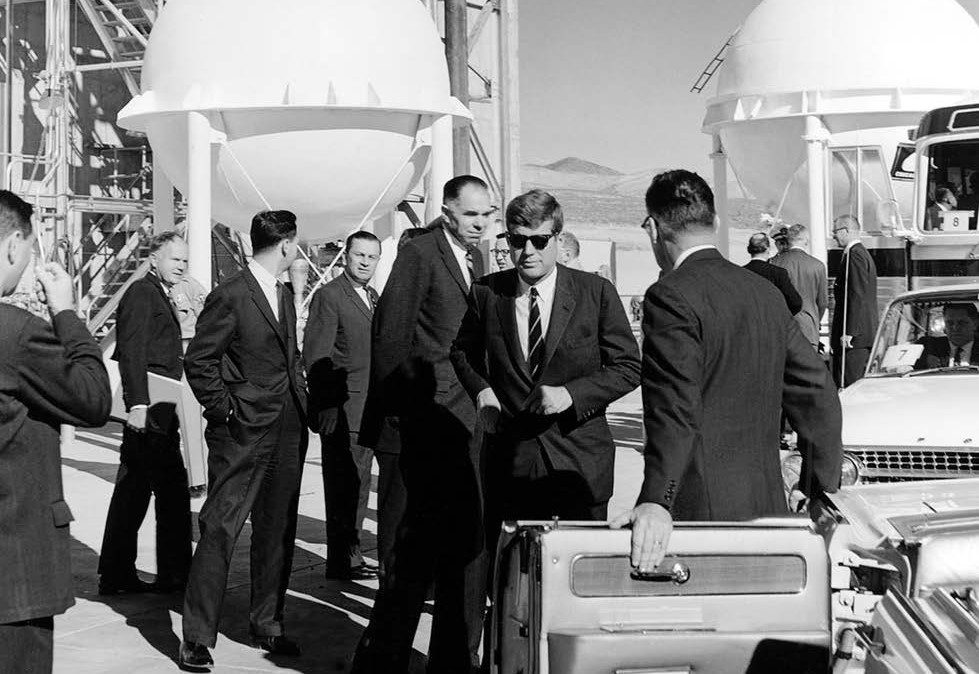
JFK visiting Nuclear Rocket Development Station: public domain;
NASA’s going nuclear. It was decreed before most of us were born. Back in 1955, the Air Force set out to design a nuclear-propelled stage for an intercontinental ballistic missile at the Los Alamos Scientific Laboratory. In 1958, a few months after the Soviets launched Sputnik, Congress held hearings on Outer Space Propulsion by Nuclear Energy. And the Air Force project was reassigned to the newly created National Aeronautics and Space Administration.
NASA was founded as “a defense agency of the United States for the purpose of chapter 17 of title 35 of the United States Code.” Its council—including the U.S. President and Secretaries of State and Defense, and the Chair of the Atomic Energy Commission—would forge “cooperative agreements” with the Army, Navy, Air Force, and Marines.
NASA’s military roots are deep.
Since 1961, NASA has deployed “more than 25 missions carrying a nuclear power system.” Today, the federal Defense Advanced Research Projects Agency (DARPA) is making a nuclear fission reactor and rocket for NASA to test in 2027. The Demonstration Rocket for Agile Cislunar Operations aims to replace chemical propellants with nuclear propulsion systems at least three times as efficient, enabling crewed flights to reach Mars.
Chemical propulsion isn’t totally passé. The demo rocket will be nuclear-powered in space, but chemically launched—to limit the potential for an accidental release of radioactive materials on the ground. NIMBY!
Wernher von Braun’s badge (1957) by Nasa-verve licensed under CCA by SA 3.0.
In 1961, John F. Kennedy found the perfect aerospace engineer for the U.S. space mission. In 1962, JFK publicly vowed that U.S. Americans would be first to set foot on the moon.
JFK’s pick, Wernher von Braun, had reached the rank of major in Nazi Germany’s Allgemeine SS paramilitary forces, invented the V-2 rockets. These monstrosities were linked to many thousands of deaths—of civilians, soldiers, and concentration camp prisoners who were forced to build Germany’s vengeance weapons.
Historian Michael J. Neufeld found that von Braun was not in charge of assignments or punishments of concentration camp prisoners, but had been in “direct contact with them and with decisions how to deploy them.” While von Braun wasn’t directly killing people, the ruin and loss of others’ lives in the course of the work didn’t seem to trouble the scientist.
In the United States, von Braun designed TV satellites and early intercontinental ballistic missiles. As part of Hermes, General Electric’s missile-making project for the U.S. Army, von Braun helped refurbish V-2s taken from Germany after the war. And von Braun led the Saturn V rocket project that launched Apollo 11, fulfilling JFK’s promise.
The Wrong Stuff
Such is the story of NASA’s formative years. Today, the agency touts its moon missions through “graphic novels and interactive experiences” for young people. Artemis 3, NASA’s first crewed mission since 1972, will feature female and Black astronauts. Take that, Gil Scott-Heron.
The European Space Administration has floated the concept of an international “village” on the moon. NASA’s Artemis Accords allow extraterrestrial mining. Israel has launched a rocket made by Elon Musk’s SpaceX. The governments of China, India, and Russia all have space stations in the works.
As the space domain becomes more contested and congested, the U.S. military Space Force is on display, maintaining Space Domain Awareness. This adolescent language might be laughable, but for the coiled aggression, obscene spending, and the natural resource depletion behind it. It might be laughable, but for the failure of humanity to ensure everyone is housed and fed on Earth. Let them eat interactive experiences?
But here we go, bringing nuclear rockets to Mars.
The Mars Project was written in 1948, and published in 1953. It contained the first technical specification for a crewed Mars flight. Its author was Wernher von Braun. (Per Twitter, the book prophesied that Elon Musk would be involved in a human Mars landing. If von Braun were looking for a 21st-century protégé, an oft-noted habit of prioritizing production over people could fortify Musk’s candidacy.)
By 1969, von Braun’s designs included nuclear thermal propulsion. Nixon sidelined von Braun’s career. And “nuclear power went out of fashion after the disasters of the 1980s,” says Joshua Frank, author of Atomic Days: The Untold Story of the Most Toxic Place in America.
“People had turned on atomic energy, so the industry was coming up with the most ridiculous ideas about what to do with all of its deadly stuff, and there was talk about dumping radioactive waste in space, or on the moon.”
Could the new boosters of nuclear technology resurrect these ridiculous plans, asks Frank, “in order to sidestep the valid concerns that radioactive waste is a poison that lasts millennia? Fortunately, at least for now, it’s simply not cost-effective to rocket nuclear waste to space. If it were, you can bet Elon Musk would be loading up his space fleet today.”
The resurgence of nuclear space projects raises these and many other questions.
To What End?
Jim Reuter of NASA’s Space Technology Mission Directorate says nuclear thermal propulsion will show our “transportation capability for an Earth-Moon economy.” The economy theme is a popular one. While Toyota develops Lunar Cruisers for NASA crews, Honda has an R&D contract with Japan’s space agency for lunar EVs. Hyundai, Kia, and Boston Robotics are all working on proprietary technologies for lunar robots and vehicles. And so on. A recent Bloomberg article titled Space Startups Are Trying to Make Money Going to the Moon sounds positively moonstruck:
“In the future, private companies could ferry people and cargo to and from the moon, creating a base to conduct science and, eventually, mine resources and even lunar ice as an ingredient to make rocket propellant. It’s a grand vision that could start to take shape this year and eventually lead to a marketplace in which companies could use the lunar environment to turn a profit…”
Anthony Calomino, a NASA research engineer, has said: “It’s important for the United States to remain a primary and dominant player in space. It is the next frontier.”
So, the main reasons for colonizing Space are: (a) because it’s there; (b) fear of missing out; (c) because there’s stuff to extract and profits to be made up there; and (d) because nobody puts a possessive nation of Homo sapiens in the corner.
Curb the Anthropocene
Why can’t our species sit down, seek some peace and quiet, and sort out our priorities? Consider race, sex, and class injustices. Consider human trafficking, animal trafficking, and habitat loss. Wars and famines. The steady disintegration of the ice caps that keep the nuclear nations physically apart, and keep Earth itself balanced, and watered with the seasons. Shouldn’t these be our preoccupations? Instead, we’re keen to expand the outsized footprint of human commerce and conflict.
If living organisms are out there, how will they withstand our acquisitive onslaughts? We lack the standing to colonize other planets. Our penchant for colonizing is, itself, a treacherous flaw. The sensitive among us are beginning to understand, and attempting to remediate, the vast and continuing harm done by the colonial mindset.
Meanwhile, humanity relentlessly drives other species and the climate itself past the brink of breakdown. If there were ever a time to “leave no trace” on nature, it’s now—on Earth and beyond.
Lee Hall holds an LL.M. in environmental law with a focus on climate change, and has taught law as an adjunct at Rutgers–Newark and at Widener–Delaware Law. Lee is an author, public speaker, and creator of the Studio for the Art of Animal Liberation on Patreon.
From Global Network Against Weapons & Nuclear Power in Space 4-3-25
Original post: By Between The Lines January 27, 2004
Interview with Bruce Gagnon, coordinator of the Global Network Against Weapons & Nuclear Power in Space, conducted by Melinda Tuhus
Last week, President Bush announced his goal of sending Americans back to the moon by 2020 and then on to Mars. He promised only $1 billion in new funds for the project over the next five years, saying $11 billion in that period will come from a redeployment of money already allocated to NASA, the U.S. space agency. While some see this as a political move by Bush to sound Kennedy-esque as his campaign for re-election gears up, others foresee a scenario unfolding that could boost the fortunes of the controversial “Star Wars” anti-missile defense system, as the U.S. seeks to extend its superpower status into space.
Between The Lines’ Melinda Tuhus spoke with Bruce Gagnon, coordinator of the Global Network Against Weapons and Nuclear Power in Space. Gagnon has worked on space issues [since 1982] and was organizer of the Cancel Cassini Campaign, an effort to stop the launch of 72 pounds of plutonium into space onboard a satellite in 1997. Though ultimately unsuccessful, the campaign attracted worldwide attention and support.
Gagnon discusses the Bush administration’s space proposal, how much it will likely cost, where the funds will come from and who stands to profit. He also lays out his hope for the world community to take space exploration in a different direction.
Bruce Gagnon: I think it’s part of a long, long-time plan to begin to build the infrastructure to use space to control the earth and then ultimately to create a 50-year, 100-year plan to control the shipping lanes between the earth and planetary bodies. There’s a plan to actually mine the skies. They’ve discovered gold on the asteroids. On Mars, there’s magnesium and cobalt and uranium. That little rover driving around Mars today, it’s not looking for the origins of life like we’re told; they’re doing soil identification and they’re trying to identify what is where on that planet. There’s helium-3 on the moon. In fact, there’s a New York Times story where they say that it will replace fossil fuels when they are gone on the earth, and helium-3 will be used for fusion reactors. Coincidentally, the U.S. never signed the 1979 Moon Treaty that outlaws permanent bases on the moon, military bases, and most importantly, says that no country or corporation or individual can claim ownership of the moon. The U.S. didn’t sign that treaty because we’ve always intended to have military bases on the moon. I have a copy of a secret Army study from 1952 that says the U.S. has to control the moon. They long ago realized that whoever controls the moon actually will be able to control the pathway on and off the planet Earth – they call it the earth-moon gravity well; whoever is at the top of the well will control who can get on and off the planet. And a congressional study in 1989 entitled, Military Space Forces: the Next 50 Years, stated that with our bases on the moon, we would be able to ‘hijack rival shipments upon return’, so that if anyone else tried to mine the sky but they weren’t authorized, we would be able to take them out on the way back. It’s high-tech piracy.
Between The Lines: Is the money, then, going to come in the future, because it seems like a very modest proposal right now.
Bruce Gagnon: The first thing they’re going to do is to close down the international space station and the shuttle program, and move that money in. But once they get the commitment from Congress that yes, we’re going to go forward with this, it’s institutionalized in the budget, then the real bucks are going to kick in. The estimates for the collective costs of these Mars missions and moon missions is about $750 billion over time [in 2004 dollars]. Well, this is a massive, massive flow of funds into the aerospace corporation coffers, at the same time, remember, that they’ve also come out with, about a year ago — the Bush administration did — the Nuclear Systems Initiative, a $3 billion, five-year program to develop Project Prometheus, the nuclear rocket with nuclear reactors for engines, and other nuclear technologies [which will soon be tested over our heads in Lower Earth Orbit]. Those little rovers that are driving around Mars today are powered with plutonium. They are talking about having nuclear powered mining colonies on the moon and Mars. So all these… increasing the number of launches with nuclear materials on rockets with ten percent failure rates is going to ensure that sooner or later there will be a nuclear accident at the time of launch.
There was an editorial in one of the industry publications called Space News [in 1999], and the title was ‘Mars missions are affordable.’ And Space News went on to say, ‘Look, we know that this stuff is going to be expensive, but we have a solution to the funding problem. So what we’re now doing is sending our lobbyists to Washington secure those funds from the Entitlement programs and moving the money into these space projects’.
Now, what are these entitlement programs that Space News was talking about? Social Security, Medicare, Medicaid, and what’s left of the welfare program today. So after the taxpayers would have paid all the years of space tech research and development, in the hundreds and hundreds of billions of dollars, when the day comes that they can actually turn profit mining the skies, in the future, what they’re going to do, and NASA has already said, they’re going to privatize everything, turn it over to the corporations who will make the money. And in fact there’s legislation pending in Congress to make all profits in space tax-exempt.
Between The Lines: Do you see any value in space travel, in space exploration done a certain way?
Bruce Gagnon: I’m not opposed to space exploration in general. I think we all have that curiosity about what’s out there, and I think it’s something that we as a planet, should over time, be expected that we’re going to want to pursue. But I think when it comes at the cost of our own life here on this planet, when it comes at the cost of our children’s education, our health care, and cleaning up our own planet — these things should come first. And then when we do move off this planet, I think we really need to have a collective understanding on earth: What kind of seed will we carry with us when we go into the heavens? Will it be this bad seed of war and greed and environmental degradation, or will it be a different kind of seed, a more positive seed? And I think right now is the time to debate this question globally. And that’s the work of our organization, to create a global consciousness and a global constituency, around this question: What kind of seed should our space program carry?
License: CC BY 4.0 arXiv:2312.09329v1 [physics.ao-ph] 06 Dec 2023
Potential Perturbation of the Ionosphere by Megaconstellations and Corresponding Artificial Re-entry Plasma Dust
S. Solter-Hunt
(December 6, 2023)
Abstract
500,000 to 1 million satellites are expected in the next decades, primarily to build internet constellations called megaconstellations. These megaconstellations are disposable and will constantly re-enter and be replaced, hence creating a layer of conductive particulate. Here it will be shown that the mass of the conductive particles left behind from worldwide distribution of re-entry satellites is already billions of times greater than the mass of the Van Allen Belts. From a preliminary analysis, the Debye length in spaceflight regions is significantly higher than non-spaceflight regions according to CCMC ionosphere data. As the megaconstellations grow, the Debye length of the satellite particulate may exceed that of the cislunar environment and create a conductive layer around the earth worldwide. Thus, satellite reentries may create a global band of plasma dust with a charge higher than the rest of the magnetosphere. Therefore, perturbation of the magnetosphere from conductive satellites and their plasma dust layer should be expected and should be a field of intensive research. Human activity is not only impacting the atmosphere, it is clearly impacting the ionosphere.
I Introduction
The Van Allen Belts are two torus-like regions of trapped solar energizing particles that protect the atmosphere. The mass of the Van Allen Belts is 0.00018 kilograms. The masses of other parts of the magnetosphere (ring current, plasmasphere, etc) are not widely estimated but are less dense than the Van Allen Belts. The mass of one second generation Starlink satellite is 1250 kilograms[8], in which all of the mass will become conductive particulate in 5 years during re-entry demolishment and will be added to the lower ionosphere for an indefinite time. Thus, the space industry is adding enormous amounts of material to the magnetosphere in comparison to the magnetosphere’s natural level of particulate and this is forming a layer of artificial plasma dust in the meteor ablation zone. Due to the conductive nature of the satellite material, this may perturb or change the magnetosphere. A depletion or change of the magnetosphere could subsequently have an impact on the atmosphere.
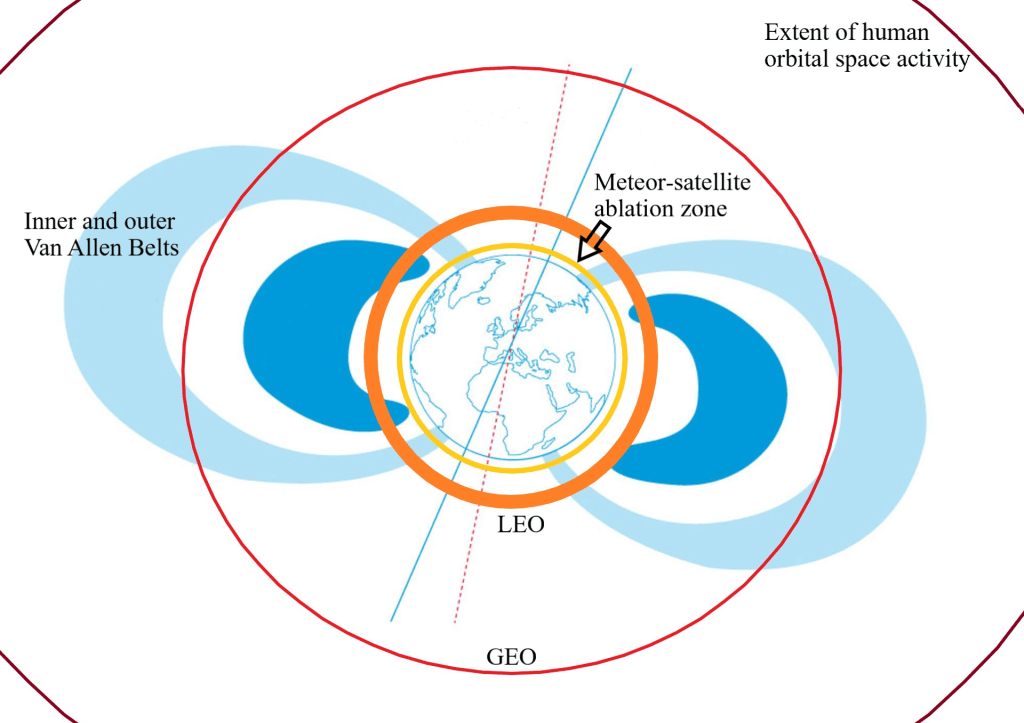
The magnetosphere is known to be weakening by 10-15% [11] and satellites are typically involved in aiding that analysis. But in the 2020s and 2030s, satellites will become so numerous that they will form their own dynamic shell of conductive material. This shell of conductive material is now much greater than the radius of the earth. As satellites fill LEO (300 km) to GEO (36,000 km), this layer of conductive material extracted from the Earth’s crust is 6 times the radius of earth. A comparison of space industry altitudes and regions with the Van Allen Belts is shown in Figure 1. Human spaceflight activity is thus creating vast regions of charged particles that may impact the Van Allen Belts and other parts of the magnetosphere in unknown ways.
[editor: LEO = Low Earth Orbit; GEO = Geosynchronous Orbit (GEO); between the two is MEO = Medium Earth Orbit]
After consulting multiple magnetosphere models, the consensus was that it would take decades to simulate 500,000 satellites within a magnetosphere model and evaluate the potential impact. If the megaconstellations and their debris are perturbing the magnetosphere, their rate of growth is too fast for decades of simulations considering the potential urgent ramifications for the atmosphere. This may be a case where neither simulation or experiment can assess the question prior to the full deployment of 500,000 satellites. Thus, this must be considered based on overall planetary-level calculations between the magnetosphere and the megaconstellations.
The space industry must fund more accurate chemical modeling of the atmosphere, ionosphere, and magnetosphere and the chemicals, debris, and materials they are adding to it. It is already suspected that the resulting re-entry alumina may increase ozone depletion [3]. Additionally, since space is not considered an earth environment, there is no regard for the sensitivity of the ionosphere, Van Allen Belts, plasmasphere, or magnetosphere. These plasma systems may indeed be more sensitive than suspected due to their low density.
In addition to general mass calculations, ionosphere data and specifically the charge effectiveness or Debye length, is examined. It should be noted that this data is only possible because of in-situ satellite and rocket measurements and thus there is no pre-space-industry data available.
II Method
A simulation of the magnetosphere and the megaconstellations is not currently feasible, and the planetary-scale experiment is underway without a direct ability to diagnose the satellite-magnetosphere relationship because the satellites themselves detect the changes in the magnetic field. Thus, calculations on the mass, Debye length, and a small scale model are compared to gauge the issue. Debye length is studied by extracting the electron temperature and density from the Community Coordinated Modeling Center of the NASA Goddard Space Flight Center. Masses and other reentry statistics are studied from Jonathan’s Space Report[6]. As space-based development and pollution grow, there is a strong need for more multidisciplinary investigations and synthesis across materials, aerospace science, chemistry, plasma physics, and climate.
III Discussion
III.1 Mass
The Starlink V2 satellite constellation (just one of many planned megaconstellations) intends to have 42,000 satellites [6], each the mass of a SUV, truck, or large car (1250+ kg). Each satellite has a planned lifetime of only 5 years (if successful and many satellites are failing sooner), thus in order to maintain the megaconstellation, 23 satellites per day will complete a re-entry burn in the upper atmosphere. This is approximately 26,308 kilograms (29 tons) of satellite re-entry material every day, just for the Starlink megaconstellation. Thus, every day, just for this one constellation, the conductive mass of material added to the upper atmosphere will be 150 million times greater than the mass of the protective Van Allen Belts. Thus, every second, just for this one megaconstellation, the mass of approximately 2,000 Van Allen Belts will be deposited into the ionosphere. Thus, the megaconstellations are creating their own plasma dust region vastly greater in mass than that of the Van Allen Belts or any other region of the magnetosphere. The South Atlantic Anomaly (SSA) is a region of the Van Allen Belts that comes closest to the Earth at 200 km and is avoided by satellites due to an increase in ionizing radiation. But the satellites themselves may be creating a more dangerous ionizing radiation zone with their reentry plasma dust.
Figure 1:Approximate schematic showing relation of human space activities to the Van Allen Belts. The relatively much-higher density debris and artificial plasma dust from human space activities are occurring under, through, and above the Van Allen Belts, suggesting that the much-higher density charged particles from these activities may disrupt the Van Allen Belts.
As of March 2023, 299 Starlink V1 (first generation) satellites have already re-entered [6] at a mass of approximately 300 kg each. This amount of material is 500 million times the mass of the Van Allen Belts. In 2022 alone, the space industry polluted approximately 2 billion times the mass of Van Allen Belts (over 500 tons) in reentry particulate and material from all launches. Since the beginning of the space industry, approximately 20,000 tons of material [7] have been demolished during reentry, meaning a similar amount may still remain as plasma dust. This amount is over 100 billion times greater than the Van Allen Belts.
This re-entry material will be globally distributed since re-entries are globally distributed. The locations of re-entries are essentially randomly distributed. Space launch regions likely have greater densities of plasma dust development. This increase in ionization in these regions could have adverse impacts for launch success as ions can interfere with electronics.
The layer of growing re-entry particulate does not dissipate when the satellite demolishes. It stays stagnant in the upper atmosphere/lower ionosphere for several years before decay into the lower atmosphere in a best case scenario. In a worst case scenario, the particulate stays there indefinitely. Since this material is replenished every day, any potential natural decay to the ground may be negligible. It should be noted that rocket and satellite exhaust are also creating plasma dust [9]. If the metal dust is settling into the atmosphere after several years, the repercussions of vast amounts of metal dust in the atmosphere includes dangers to the ozone [3] but any other potential impacts are unknown.
III.2 Debye Length
Even with 500,000 satellites, the average distance between those satellites will be in the hundreds of kilometers. However, the satellites will still have frequent near passes in the hundreds to thousands of feet, possibly overcoming the Debye length of the ionosphere and magnetosphere in some regions.
More concerning is the density of aluminium particulate and other conductive metal particulate that is rapidly accumulating in the lower ionosphere after reentry demolishment of entire vehicles. These metals from satellites are already clearly measured in the stratosphere [10]. The satellites break up at 60 to 70 km, and here the ionosphere has a Debye length of approximately 1.5 meters on average between day and night conditions [5]. As shown in Figure 2, the Debye length goes up in the meteor ablation zone, however, this is likely from space debris and not meteors, as conductive material from satellites has far exceeded meteor material. If it is known that the Debye length has increased noticeably from meteor aluminium, then high concern should be placed upon the vast amounts of satellite aluminium. It is estimated that the meteor ablation zone gets approximately 50 tons of meteorite material per day – but the charged dust from that amount is approximately 1 percent (450 kg)[3]. Thus, one next generation Starlink (1250 kg) creates almost 3 times as much charged dust as all meteorite material in one day. If the amount of meteor aluminium and the corresponding charged dust has created an increase of Debye length by approximately 0.3 meters and satellite dust is approximately 60 times that (using the Starlink constellation alone), then assuming proportionality of this trend, the satellite aluminium from Starlink alone would potentially increase the Debye length by over 17 meters. This would be nearly double the Debye length of the Magnetosheath, which is 9.5 meters [4]. The Debye length in the ionosphere and magnetosphere ranges from a few centimeters to a few tens of meters. Therefore, all satellite reentries are on a trajectory to create a band of charge higher than the rest of the magnetosphere. If this estimation is correct, Starlink reentries alone could be impacting the ionosphere.
Figure 2:In this figure using CCMC data, it is shown that the electron Debye length increases at the meteor ablation zone in the lower ionosphere. This could potentially have been from space debris. This data is from 2010 and space debris has increased dramatically since. If it is believed that there is an increase in Debye length from meteorite aluminium, then the effect is stronger for reentry material, which has vastly exceeded the meteorite aluminium. As shown here, the increase in the Debye length is at the top of the ablation zone, further suggesting this is from space industry reentries.
The ion Debye length, which includes mobile ions, is given by
The electron Debye length, which is extracted here from CCMC data, is given by
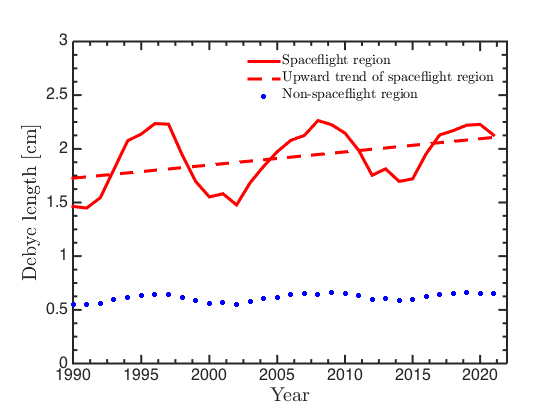
According ionospheric models, the lower regions of the ionosphere are particularly difficult for acquiring data and measurements. These regions are too low for satellite in situ measurements and difficult to sound from the ground typically because of the low ion/electron densities and high neutral densities. So data in this region on electron density relies on rocket measurements [2]. However, data in a region slightly higher than the meteor ablation zone, already shows there may be concern because spaceflight regions are showing much higher Debye lengths than non-spaceflight regions, as shown in Figure 3.
Figure 3:In this figure using CCMC data, it is shown that the electron Debye length at 100 km in spaceflight regions is much higher than non-spaceflight regions. The Debye length in spaceflight regions is trending up over time. This illustrates that human activity is having an impact on the ionosphere. Here Kennedy Space Flight Center is the spaceflight region and Reykjavik, Iceland is the non-spaceflight region. It is preferred to compare Debye length in the meteor ablation zone, but the exact values are more difficult to acquire because ionosondes and satellite measurements here are less reliable.
III.3 Plasma drag
Plasma drag occurs when charged particles are trapped in a planet’s magnetic field. These charged particles can overtake the magnetosphere depending on their location and density. Drag is directly related to density and since it has been shown here that the masses of artificial plasma dust are going to create regions of charged particles with a much higher density than elsewhere in the magnetosphere, it should be expected that plasma drag within the meteor ablation zone is going to overtake the other regions of the magnetosphere.
III.4 Small-scale Scenario
In a basic physics consideration, a spherical magnet (analog Earth) surrounded by a conductive spherical mesh (analog megaconstellations) would induce a drop in magnetic field outside of the conductive spherical mesh. This would allow solar energizing particles to more easily reach the satellite regions (and atmosphere) and cause satellite failures and thus further stratify the ionosphere with conductive particulate. The complication is that the spherical mesh in this scenario is very wide (6 times the radius of Earth) and whether this circumstance is more adverse is unknown.
However, the layer of the conductive particulate from satellite and spacecraft reentry demolishment may rapidly condense at current rates of activity. This layer of metal particles in the lower ionosphere, where the Debye length may become stronger than the natural ionosphere, will become a conductive shell of material. Inside the shell, the electric field tends toward 0. Thus outside the shell, the magnetic field tends toward 0.
III.5 Magnetosphere Loss on Mars and Dust on Earth
It is thought that the loss of the magnetosphere on Mars may have involved separation of planetary materials in the core of Mars [13]. The space industry on Earth is taking vast amounts of conductive materials naturally found on the surface and in the crust and injecting them into the ionosphere and beyond, causing a new stratification of planetary material.
Mars, nearer to the asteroid belt, may have endured more meteor ablation involving aluminium and other metals. This may have played a part in the magnetosphere erosion, which the space industry is now accelerating with incessant satellite reentry demolishment.
Additionally, further research regarding the Chicxulub impact [12] indicates that the dust from the asteroid was a key mechanism in the extinction of dinosaurs and life in this period. The space industry is replicating this type of asteroid dust with more extreme chemicals, dynamics, mass, and combinations that have not had sufficient study at this time. At 1250 kg per satellite, only approximately 100,000 to 150,000 satellite re-entry demolishments are needed to meet the approximate mass of the Chicxulub impact.A new estimate [3] indicates that 1 million satellites are expected to be maintained and regularly demolished in total.
IV Conclusion
With the estimated projected values for the Starlink megaconstellation alone (approximately one 1250 kg satellite per hour re-entering), every second the space industry is adding approximately 2,000 times more conductive material than mass of the Van Allen Belts into the ionosphere. It appears assumed by the space industry that the magnetosphere and Van Allen Belts are indestructible, when in fact the nature of their composition is delicate and billions of times less massive than the conductive material being added to the magnetosphere on a regular basis. Continued monitoring and analysis of this artificial charged dust in comparison to the natural charged dust is needed.
It is known that man-made chemicals can endanger the atmosphere, and the megaconstellations are not just depositing dangerous chemicals, they are depositing huge masses of conductive material. It is known that injecting fossil fuels into the atmosphere, originally from below the Earth’s crust, is risking the habitability of Earth. It appears likewise for injecting metals from the ground and crust into the ionosphere. Using just estimates from Starlink reentry masses, the Debye length of the ablation zone may increase to over 17 meters if the planned reentry demolishment of 23 satellites per day occurs. This amount, if globally spread and amplified by hundreds of other planned and developing megaconstellations, would cause perturbation to the magnetosphere because it would out-compete the Debye length elsewhere in the nearby magnetosphere and magnetosheath. It may be the case that satellites, reentry particulate, and conductive space debris may cause further weakening and perturbations of the magnetosphere.
V Acknowledgement
This work was made possible partly by the satellite monitoring and tracking work of Dr. Jonathan McDowell of Jonathan’s Space Report, as well as by the open source data of the Community Coordinated Modeling Center (CCMC). The editing and support of Dr. Samantha Lawler of University of Regina also made this work possible. I’d like to also acknowledge Dr. Andy Lawrence for leading the Starlink FCC appeal, which spurred some of this research.
VI References
[2]↑Bilitza, D., Pezzopane, M., Truhlik, V., et al, 2022, The International Reference Ionosphere Model: A Review and Description of an Ionospheric Benchmark, Reviews of Geophysics, doi: 10.1029/2022RG000792.
[3]↑Boley, A. and Byers, M., 2021, Satellite mega-constellations create risks in Low Earth Orbit, the atmosphere and on Earth, 11, 10642, Scientific Reports, doi: 10.1038/s41598-021-89909-7.
[4]↑Champion, K. and Schaub, H., 2022, Effective Debye Lengths in Representative Cislunar Regions, 16th Spacecraft Charging Technology Conference.
[5]↑Mann, I., Gunnarsdottir, T., Häggström, I. et al, 2019, Radar studies of ionospheric dusty plasma phenomena, doi: 10.1002/ctpp.201900005.
[9]↑Merlino, R., 2021, Dusty Plasmas: from Saturn’s rings to semiconductor processing devices, 6, Advances in Physics, doi: 10.1080/23746149.2021.1873859.
[10]↑Murphy, D., Abou-Ghanem, M., Cziczo, J., et al, 2023, Metals from spacecraft reentry in stratospheric aerosol particles, The Proceedings of the National Academy of Sciences, doi: 10.1073/pnas.2313374120.
[11]↑Schiermeier, Q., 2013, Mission to map Earth’s magnetic field readies for take-off, Nature, doi: 10.1038/nature.2013.14212.
[12]↑Senel, C., Kaskes, P., Temel, O. et al, 2023, Chicxulub impact winter sustained by fine silicate dust, Nature Geoscience, doi: 10.1038/s41561-023-01290-4.
[13]↑Yokoo, S., Hirose, K., Tagawa, S. and et al, 2022, Stratification in planetary cores by liquid immiscibility in Fe-S-H, Nature Communications, doi: 10.1038/s41467-022-28274-z.
Trump signed an Executive Order to build an Iron Dome for America, which aims to defend the homeland “against ballistic, hypersonic, advanced cruise missiles, and other next-generation aerial attacks.”
It’ll also importantly include space-based monitoring and interception systems. Some of the latter will have “non-kinetic capabilities” too, likely referring to directed-energy weapons (DEWs), but it’s unclear whether they’ll be deployed on the ground and/or in space.
Here are five takeaways from this monumental move:
* * *
1. Strategic Stability Will Never Look The Same
Bush Jr.’s unilateral withdrawal from the Anti-Ballistic Missile Treaty in 2002 prompted Russia to develop hypersonic technology so as to prevent the US from feeling comfortable enough with its missile defense shield that it one day plots a first strike after thinking that it could intercept Russia’s second one. Trump’s Iron Dome plans mean that there’s no going back to the era of mutual restrictions on missile defense, which was already dubious after what Bush Jr. did, thus worsening the Russian-US security dilemma.
2. The US Just Sped Up The Second Space Race
The second Space Race has already been underway since Trump created the Space Force in 2019, but his latest Executive Order sped it up by compelling Russia and China to further prioritize their space-based defense plans, which will inevitably result in the hyper-militarization of space. There’s no way that those two won’t suit through the deployment of their own defensive systems there that could also disguise offensive weapons just like the US might secretly be plotting to do under this pretext.
3. “Rods From God” Are The Next Superweapon
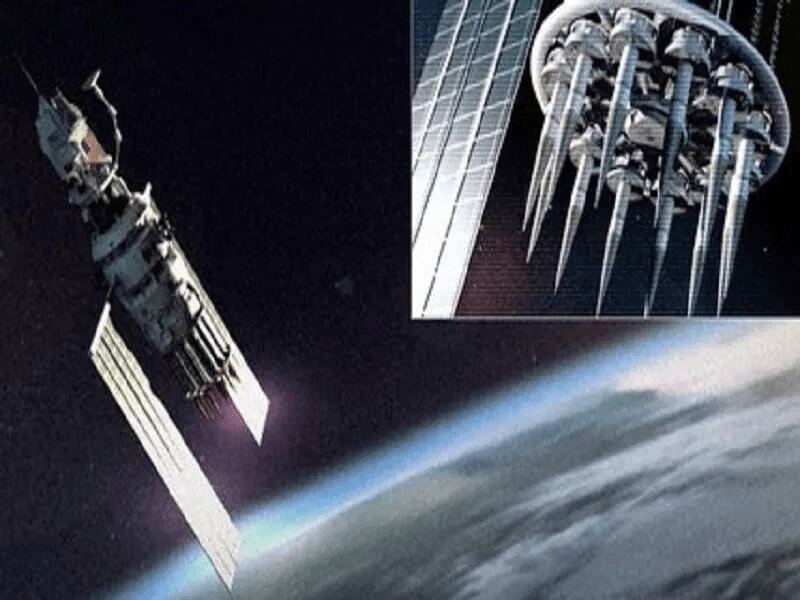
Whichever country is the first to position itself to carry out kinetic bombardments against others, which refers to dropping space-based projectiles onto their opponent, will obtain dominance. These weapons are popularly known as “rods from God”[https://newspaceeconomy[dot]ca/2023/07/09/the-rod-of-god-theoretical-kinetic-energy-weaponry-from-space/] and are poised to become the next superweapon since they might be impossible to intercept and can promptly strike opponents due to menacingly orbiting above their targets or in close enough proximity to them at all times. This makes them a military game-changer.
4. This Is An Unprecedented Power Play By The US
The preceding points prove that Trump’s Iron Dome plans are an unprecedented power play against Russia and China. The unofficial “rods from God” offensive element raises the chances that the US can destroy their land-based second-strike capability in a first strike while the official missile defense one is meant to neutralize their remaining (submarine-based) capabilities. The combined effect is intended to place them in positions of nuclear blackmail from which concessions can then be perpetually extracted.
5. Space-Based Arms Control Should Be A Priority
Russia and China will work to counteract the US’ aforesaid power play and then unveil their own such systems so as to try to place it in the same position of nuclear blackmail that it wants to place them. This is a dangerous dynamic since one of these three might feel like time is running out before they’re placed in such a position and that they must thus launch a first strike without delay. The only way to reduce this risk is through a space-based arms control pact with credible monitoring and enforcement mechanisms.
* * *
Trump’s plans to build an Iron Dome for America are a game-changer in the New Cold War since they’ll take the US’ rivalry with Russia and China to a qualitatively more dangerous level.
The consequent hyper-militarization of space that’ll occur as a result of him wanting to deploy interceptors there, which could disguise offensive arms like “rods from God”, spikes the risk of war by miscalculation.
A space-based arms control pact between them is unlikely anytime soon, but it’s the only way to reduce this risk.
Friday, May 10, the U.S. Space Force gave a presentation to the California Coastal Commission on Vandenberg Space Force Base operations. This included their development plans.
Item #7 Energy, Ocean Resources & Federal Consistency a. Informational presentation on Vandenberg Space Force Base operations. Presentation by the U.S. Space Force on space launch and landing operations at Vandenberg Space Force Base.
https://cal-span.org/meeting/ccc_20240510/ Meeting video with Presentations: Space Force presentation begins at 1:53:10,; public comment and commission comment follow. USSF Presentation: Side menu under Presentations — click the down arrow, and select “public-f7a-titus.pptx” for Space Force presentation.
Thursday, January 23 6 pm Pacific Time Virtual public meeting US Space Force, Vandenberg
The Dept. of Air Force is preparing an Environmental Impact Statement (EIS) on changes to the SpaceX launch program at Vandenberg, and seeking public comments. Proposals include:
>> Alternatives being analyzed in the EIS are Proposed Action, Alternative 1, and the No Action Alternative
• Under the Proposed Action, the DAF would authorize Falcon 9 and Falcon Heavy launch and landing operations at SLC-6, including modifications to SLC-6 required to support those operations and construction of landing zones. The DAF would also authorize an increase in Falcon 9 launches from SLC-4, which currently hosts Falcon 9 launch operations, and an increase in downrange landings on a droneship in the Pacific Ocean. The overall launch cadence for Falcon 9 and Falcon Heavy at both SLCs, combined, would be 100 launches per year. No modification of SLC-4 infrastructure is proposed. The FAA would issue or modify a vehicle operator license for Falcon 9 and Falcon Heavy operations and approve corresponding temporary airspace closures for operations. Under the Proposed Action, the existing horizontal integration facility (HIF) located north of SLC-6 would be modified into a hangar for use by SpaceX to support Falcon 9 and Falcon Heavy operations.
• Alternative 1 is the same as the Proposed Action except rather than modifying the existing HIF, DAF would authorize SpaceX to construct a new hangar south of the HIF and north of the launch pad at SLC-6.
• Under the No Action Alternative, the DAF would not authorize any Falcon 9 or Falcon Heavy launches or landing operations at, or modifications to, SLC-6, nor would the DAF authorize additional Falcon 9 launches from SLC-4. SpaceX would not apply for an FAA vehicle operator license for Falcon operations at SLC-6 or increased launches from SLC-4.
Public Comments:
Comments must be postmarked or received electronically by Jan. 27, 2025. Public scoping comments can be submitted in English or Spanish in the following ways:
• In-person at one of the three public scoping meetings
• Via online comment form
• Email to: info@VSFBFalconLaunchEIS.com, with the subject line “Falcon EIS”
• Mail to:
ATTN: VSFB Falcon Launch EIS c/o ManTech International Corporation 420 Stevens Avenue, Suite 100 Solana Beach, CA 92075
The DAF will consider each comment during the EIS process, and all comments will become part of the public record. Comments, including attachments, must not exceed a 20-megabyte file size. Do not submit confidential, sensitive, or protected information.
Next steps:
The DAF will release at draft Environmental Impact Statement (EIS) and open another public comment period in Spring/Summer 2025.
Following that, DAF will issue a final EIS in Fall 2025.






 Free The Sky